Assessment Philosophy/Pre-internship Reflection

During the course of the semester, my assessment philosophy changed slightly. I have realized the importance of quality assessment tools that can reach all of our learners. I grew up with a system that revolved around heavily weighted finals exams, along with various quizzes and assignments throughout the semester. This is not the type of environment that I want to create for my students; I want them to see that there are many different ways of learning and understanding. Tomlinson & Moon (2013) state that differentiation is seen as a teacher’s proactive response to learner needs. Without this aspect of differentiation, our students are not being given the tools that they need to be successful throughout their schooling.

The article by Dochy & McDowell (1997) and the article by Tomlinson & Moon (2013) both discuss the role of teachers and how this continues to change. Tomlinson & Moon (2013) discuss how classrooms function today by stating that“They learn how to collaborate. They use their complementary skills to enable each member to capitalize on strengths and minimize weaknesses. They learn responsibility for themselves, for one another, and for class processes and routines.” While Dochy & McDowell (1997) discussed how teachers have a much different role today than they did years ago. The 16-year gap between these two articles shows that the issues we seen in education back then, are still trying to be resolved today. One thing that I witnessed during pre-internship was the implementation of sanctions in schools. At first, the main concern of many students (especially in a physical education setting) was that extra-curricular sports were being cut from schools. What these students weren’t recognizing was that the main thing educators are fighting for is education related, not sports related. Teachers and school staff are still fighting for ways to better the education of young children and youth. This is a fight that I believe will continue for years to come.

One article that stuck with me during pre-internship, was written by Volante (2006). In this article it was discussed how many teachers struggle with assessment practices, mainly because they typically fall back on the assessment methods that were used as they went through their schooling. This is something that I fear doing. I want my students to have a better experience than I had, rather than the exact same experience. Volante (2006) shared a variety of ways in which students can be assessed; it does not have to always be assignments and exams. There are so many ways that I can assess my students understanding of content without always putting the stress of exams on them.

Unfortunately, with pre-internship being cut short, I do not feel as though I received much practice with assessment. My partner and I had a mini unit planned in health 9, and our co-operating teacher told us that the most realistic thing to do would be to have a form of assessment after the 3-day mini unit. However, we never got to this point, so we did not get to try out any real form of assessment. Going into internship with one week of teaching experience is a bit intimidating. Throughout my degree, I feel like I have been more than prepared when it comes to lesson planning. When it comes to creating assignments and assessment tools, I do believe that I need more practice, and I am hoping this will come with experience in the field.

Assessment and Pre-internship

The article by Claypool & Preston (2011) discusses what we can do as educators to ensure that the Indigenous students in our class are getting everything that they need to be successful. In the beginning of the article, it is mentioned that Indigenous ways of knowing need to be infused into curricula, in all subject areas. This is something that educators throughout Canada are currently working to achieve. However, there are many struggles that come along with this. When looking at assessment, Preston (2011) states that “Westernized standards for student assessment are often presented through processes that are subject-specific, time-bound, competitive, and based on written documentation depicting quantifiable results.” Assessment is very westernized in the fact that students are always encouraged to get high grades, mainly to better their opportunity to get into a post-secondary institution. This can easily be related to the video that my classmates and I created on equitable assessment. The standardized testing of students is basically comparing them to other schools, provinces and even countries to see who ends up “on top.” Shouldn’t our students be tested on their actual ability to learn, rather than what they can regurgitate on an exam?

Claypool & Preston (2011) also discuss how the Indigenous students in our classrooms need to feel a sense of connection; this is something that is complicated to understand when looking through a Western Worldview lens. When Claypool & Preston (2011) talk about the cycle of learning and assessing, they mention this idea of “self-family-community.” This is an aspect that many educators may not take into consideration. By having this constant cycle, it is allowing students to see the purpose behind the learning that they are doing, and it also allows the students to reflect personally on the ways in which the learning can benefit them. With such a focus on cognitive learning, students are missing out on the other dimensions of wellness that also lead to learning.  Claypool & Preston (2011) mention that “without traditional and cultural knowledge of self (which is intricately connected to self-confidence), a person is susceptible to social, psychological, and learning problems.” This brings everything back to the cycle of learning that was mentioned above. Learning needs to be more of a cycle rather than something that is seen as a linear progression.

Some concerns I have about assessment are related to effectiveness. I fear that my assessments will not be practical or effective. Being in a gymnasium, I think it may be more difficult to assess students and keep track of their learning.

For my cooperating teacher, I would mainly like to know some of the ways in which they assess in a gymnasium setting. Through the video project we did, we discussed standardized testing. This is something that I have not heard of in a physical education setting, so I would like to know how teachers can ensure that students are receiving the proper education. There is also a  lot of controversy around fitness testing for students. This is something that I would like to ask my coop about, and whether or not they see a need for it in physical education.

Rubrics

Chapter 2 – Common Misconceptions About Rubrics (Brookhart, 2013)

Rubrics can be confusing for our students if they are not created in relation to the learning objectives. It is also stated that rubrics are not assignment directions, which I think is a valuable aspect to take into account. I believe that students still need to be able to be creative and figure things out on their own. I believe teachers need to place more of an emphasis on the process rather than the product of an assignment, although there is a place for both. It was also interesting to see that no matter the teachers experience, there were still flaws that could be found in their scoring tools. By missing key pieces in the assessment, it is likely that students are also missing a key piece in the assignment portion as well. Teachers often miss the mark on rubrics by assessing the task and not the outcome, which I find interesting because many of us think about how to assess the task. However, I do see the issue, as there are outcomes and indicators that we, as educators, need to hit. If we don’t hit these outcomes, the students are not understanding everything that they should. The overall goal is to give students opportunities to demonstrate that they have reached the learning outcome that was set out. It is also important to realize that a rubric is not a checklist for yourself or students to use.


One quote that I found really important in this reading is as follows: “one particularly uninterested student raised his hand and asked if I was going to give the class a rubric for this assignment.” She realized that her students, presumably having grown accustomed to rubrics in other classrooms, now seemed “unable to function unless every required item is spelled out for them in a grid and assigned a point value. Worse than that,” she added, “they do not have confidence in their thinking or writing skills and seem unwilling to really take risks” (Kohn, 2006). This particular quote made me realize that many of our students may just be trying to get the best grade possible, rather than trying to actually learn the content. By always giving our students an exact checklist and rubric to follow, they are losing all responsibility for themselves. This is something that I am still guilty of, even in university. I base my projects off of the rubric I am given so that I will hopefully receive a good grade. However, I am now seeing how much that can hinder my learning. I often can’t remember things that I have learned in the past, likely because I just did it for the mark, rather than for my own learning. This is something that I don’t want my future students to be doing.


Andrade (2005) shares this idea of rubrics helping teachers stay organized, which is something I hadn’t really thought of. Rubrics allow us to set out expectations and where we need to focus our instruction. These same rubrics help students to understand what the point of an assignment is, but this is something I still think we need to be cautious of; we don’t want to give students a rubric that resembles a checklist.

Principles that Underlie Assessment

The article by James (2006) discusses the relationship between assessment and learning. Throughout the article it is discussed that not only does assessment need to be aligned with learning objectives, but it also needs to be effective. This article also gives examples of different classroom assessment practices which I found rather interesting. This section of the article opened my eyes to the ways in which some educators may be assessing their students knowledge. In the first example, the student is completely secluded from the classroom environment and given what seems to be an exam. Putting this type of stress on a new student who is beginning to focus on a new language can be very stressing to the student. I personally do not believe that this is an ideal way to assess the knowledge of a student, however I do understand that schools are still required to do standardized testing in such a way throughout the school year. In contrast, the third example is similar to the ways in which we are encouraged to assess today. The student is included in what the rest of the class is doing, and they are provided with all of the supports that they need to be successful. In the article, there are a few theories of learning expressed; I would like to focus on Pavlov’s theory of learning. Although his research may be outdated, there are many valuable points that he raised through his research. I think the most important piece is that “environment for learning is the determining factor” (James, 2006). As mentioned above in the different examples of assessing, it is clear to see that students thriven the environments that have the supports that they need. I do not believe that there is one theory that hits the nail on the head when it comes to student learning. However, if all theories are used in combination with eachother, we can see how the pieces fit together and how we can use this previous research to reach all students in our classes.

Hinchey (2010) raised a very interesting point in the very beginning of the article. Hichney uses the topic of music to express how many of us are set in our ways simply because we have been introduced to it, and we have not had many other experiences to alter the ways in which we think. I think this is especially true when it comes to teaching for various cultures that we will experience in our time as teachers; I know that I will continue to struggle with this. I do not have much experience with cultures other than my own, but I am continuing to educate myself in order to better the learning experience for my students. The article discussed positivist learning and the expectation that our student will know more upon exiting school than they did when entering. Our roles as teachers is to become and expert on a specific topic in order to relay that information to our students. However, it is also our responsibility to ensure that our students learn that information and comprehend it, rather than being able to recite it on an exam just to forget it the next day. Constructivist learning was a bit harder for me to understand because I feel like I never really experienced it throughout my schooling. The idea of allowing students to experience the information from themselves, and in a way, teach themselves is something that I think every student needs. Children and even adults need to be able to figure things our for themselves and I think this constructivist view really helps me to understand how to do so.


keywords: behaviourist, constructivist, positivist, socio-cultural

Meaningful Feedback

Providing meaningful feedback is something that I believe I currently struggle with as a pre-service teacher. A lot of what we do as becoming teachers, is provide feedback to our peers on what could be improved upon. We often discuss the “sandwich method,” where you provide one good thing, one thing to improve, followed by something else that was successful. Although I do see the value in using this method, I also think it is important to narrow down your focus when providing feedback.  The article by Sackstein discusses the importance of focusing on one or two points, rather than providing feedback on everything at once. I think this is important no matter who is providing the feedback, as listing too many things that can be improved is often overwhelming for the learner. Another aspect discussed by Sackstein is that even though a student might be receiving positive feedback, it may be meaningless. It is important to be extremely specific when providing feedback, whether it is positive or negative. Students need to know and understand when they are doing things properly and successfully just as often as they need to know how to improve. I really like the concept of teaching students how to use feedback. This is a skill that I think many students miss out on throughout schooling. It not only allows them to better the learning of their peers, but it also allows them to be more successful themselves. I also really liked the point from Sackstein about providing feedback in student friendly ways. This ensures that our students can comprehend the feedback that is given, along with relating the feedback to the learning goals that students have set out for themselves. Having students set our their own goals teaches them responsibility and holds them accountable for their own learning.

Sackstein also covers the topic of what to do when you have  students who are reluctant to accept feedback that is given to them because they believe that what they have done is good enough. This is something that I think teachers need to discuss with students in order to help them understand that they do not need to be offended or upset about feedback that is given to them. In contrast, students who are providing feedback need to be aware that they can point out things for improvement without hurting their peers feelings. The point of feedback is to learn and grow from mistakes, rather than give up altogether when they stumble.

Another aspect of this reading that I thoroughly enjoyed, was the idea of creating rubrics with your students. This once again allows students to learn about responsibility and self-accountability. I believe that if our students have a say in what they are being assessed on, they will be more successful. Creating these rubrics allows students to see (and decide on) what their assignment needs to include, rather than just hearing it from their teachers and forgetting the assessment criteria shortly thereafter.

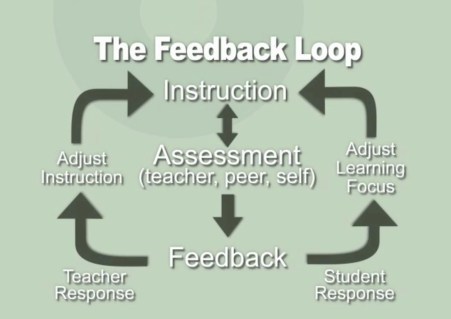
In the first video segment, it is mentioned that students often receive their marks, then calculate what percentage they got and then put away the assignment. I know that I was also guilty of this, and still even do it to this day. We live in a society where there is an emphasis on numerical grades rather than comprehension and retainment. I also like how the process of providing feedback is broken down into a feedback loop. This is an excellent visual aid that allows me to see all of the components that go into providing quality feedback for my students.

Image 2020-01-21 at 7.29 PM

The videos discuss how feedback should be consistent and continuous throughout, rather than produced solely at the end of the task that is being completed. I easily related this to the class clapping activity that we did a few weeks ago in class. We learned from that activity that our students will be more successful if they are consistently given feedback. However, this feedback must be meaningful, in that it must show students what they can do to achieve a higher mark, or better their understanding of what is being required of them.

Assessment in the 21st Century: Why We Can No Longer Rely on Traditional Forms of Assessment.

When reading through the text by Dochy & McDowell (1997), I noticed many similarities to an article that I read in ECS 310. Both articles discussed how teachers roles are changing very quickly and as needed. One of the most constant changes/improvements that is being made in the educational world, is that of technology. Both teachers and students are learning new ways that technology can be used in the classroom, as well as how beneficial this use of technology can be. In the Dochy & McDowell article, it is also mentioned that as educators we are trying to shift from giving instruction in a way that essentially meant students were required to remember everything, into a new way of educating in a way that allows students to engage themselves fully and to truly learn.

I believe that this “new” way of educating our students will provide them with the skills needed to thrive outside of a school setting. In the Saskatchewan curriculum, one of the goals is to create lifelong learners. As educators, how can we build lifelong learners, if the basis of our program is for our students to remember what they are told, rather than letting them engage and truly learn the skills needed? This is something that I know I struggled with in schooling. Without being able to work with the material and truly figure it out, there was no way that I would remember it. With that in mind, it is easy to see how assessment practices also need to be adapted to every teaching method. We are moving away from the idea of administering exams and handing our worksheets. Therefore, assessment can not be done in the same way as it has been previously. We are to assess student learning rather than if they got the multiple choice questions on their exam right.

Roswell & Walsh (2011) discuss the characteristics of new literacies and what it is that drives these changes. One topic that is mentioned is that of reading and writing on screen, which is related to the point I made previously about technology in the classroom. Although I do understand the benefits, I also have a problem with students doing their reading and writing online or with technology. Although it may make assessment easier, in ways, I do not believe it is necessary. Young students still need to learn how to spell and write properly, along with learning how to form proper sentences, and this is something that technology can correct for them, rather than them truly learning. As a physical education major and health minor, my mind also takes me to the extremely high levels of screen time that young children and youth are already experiencing and how that impacts their health.

Why are we assessing? What is it for?

When looking at the methods of assessment, it is clear to see the value behind each of the several principles for effective assessment listed by Volante (2006). As a future educator it is important for me to understand what it takes to provide my students with assessments that are functional.

One of the fears that I have as a becoming teacher is ensuring the alignment of my assessments with learning targets that I have for my students. I do not have much practice with putting this into place yet, but I am hoping that my pre-internship will allow me to better prepare for assessing all future students. Volante (2006) mentions that “new teachers have experience only with the assessment measures that their teachers used when they were students.” I believe this to be true. Throughout my schooling I was never fully aware of what I was being assessed on, which is something that I think is unfair to students. This alignment is fundamental in student success. If students are unaware of what they are being assessed on, or if it does not align with their own personal qualities, they may not be successful. Building relationships with students may also be extremely beneficial for assessment purposes.

The article written by Volante (2006) also shows many examples of different assessments that can be done. Knowing that all of our learners will have different experiences and learn in different ways is vital in determining how to assess. As we know, there are various types of learning styles which we will undoubtedly encounter in each of our classes. Therefore, we must be able to assess in various ways to reach all of these learners.

Brown, Race and Smith (1991) discuss many assessment techniques that can be used as teachers, as well as how to ensure that your evaluation process meets all of the required aspects. One of the most important things that I read in this handbook states that assessment needs to resemble, as closely as possible, what you want your students to learn. I think this is a great way to view assessment as it can sometimes be very overwhelming but viewing it this way allows educators to break it down into simpler aspects and build off of that. I also like how they discuss the adaptive dimension to assessment, as it once again shows the importance of understanding our students. I personally believe that if you are not relational with your students and you don’t understand how they learn best, you will be unable to adequately assess your students. It is also important to take into account that assessment practices will vary from year to year, as the classes you teach will also change.

Another aspect that I think is important to consider is that not everything needs to be assessed. Learning can be done without having to assess students on every individual thing that they do. Assessing too much adds much more work to the teachers plate. If assessment is meaningful and purposeful, there should be no need to over-assess.

What is Assessment?

Assessment is a way for us to view how our students are doing in regards to the content that is being taught to them. It allows teachers to see if students are understanding the information being taught. Assessment also allows for teachers to see what areas can be improved upon by the teachers themselves. By completing assessments throughout the semester, and by having our students take part in self-assessment, we are able to see where our students are struggling and need more help to be successful. If all assessment is held off until the end of semester, our students are not receiving the education that they need. We cannot assume that all of our students understand what they are being taught.

With varying instructional strategies, assessment tools will also be changing. Teachers need to realize that not one assessment tools can be used for each type of teaching method or assignment. There are many ways in which educators can asses their students. Each assessment should be related to the assignment or activity completed by students. Students also need to be aware of what they are being assessed on, in order to limit surprises and reduce the stress of not knowing what they need to be completing. It provides the students with the expectations that you are requiring of them, and it provides the students with the criteria that they need to reach. One way to ensure students are aware of what is expected, is to have them co-construct the ways in which they will be assessed. 


Summary of Learning

I thoroughly enjoyed the fact that we were to summarize our learning from this course. I believe that it enabled me to review the entire course and pick out what resonated with me, and then discuss my learnings for others to hear. This is something that I have not typically done – its mostly memorization for a final rather than actually remembering the content and why it is important. Through this video, you will hear about the main points that I personally learned throughout the semester. I kept it short and concise as I knew if I started to get into too much detail, my video would have been WAY too long.

Please enjoy watching and listening!


Mathematics

When I was taught mathematics, it was done in a very typical way that I am sure many of us have experienced. Math was taught from a textbook, with the teacher walking us through examples on the board. We copied this information down into our notebooks, and we worked on the assignments that came directly out of the textbook. What our teacher may not have realized was that many of us (in my class) learned much better from being able to do things hands on. This simply was not something that was offered to us for most of our schooling. Math certainly did not incorporate culture or other ways of achieving an answer. You did it the way in which your teacher expected you to. I think that as teachers, we need to incorporate many ways of learning, not only the ways in which we personally learned best. Not all of our students are going to be just like us.

In Poirer’s article, it is discussed that math is a social construction; therefore, it is shaped and influenced by community. Eurocentric ideas are most related to using math in its intended way (based on Eurocentric values and nothing else). In the Inuit community, math is taught to young students in their own language, for 3 years. Th curriculum that we see today does not place an emphasis on strength in varying areas of math. In the current model of curriculum, you must be good at the math methods you find in the curriculum/textbook and anything else is almost seen as irrelevant. Along with that, the ways in which math is taught in a typical classroom is very Eurocentric. The ways in which math is taught does not take into account varying cultures or methods of achieving an answer. Without having teachers who come from various cultures, it is difficult to implement teaching math and relating it to culture, likely due to the fear of doing it wrong.


Create a free website or blog at WordPress.com.

Up ↑

Design a site like this with WordPress.com
Get started